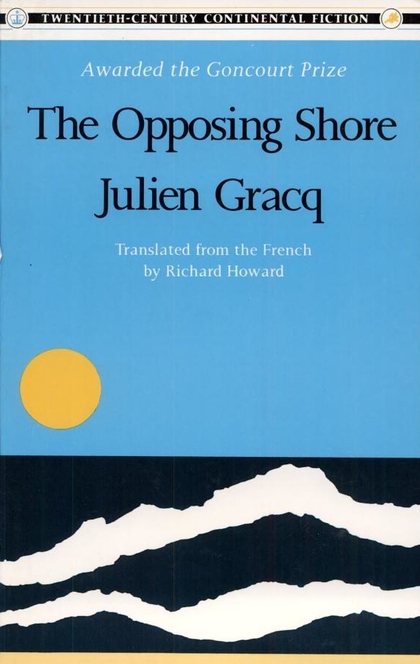
The Opposing Shore
Updated:
7 Sep 2020

With four elegant and beautifully crafted novels Julien Gracq has established himself as one of France's premier postwar novelists. A mysterious and retiring figure, Gracq characteristically refused the Goncourt, France's most distinguished literary prize, when it was awarded to him in 1951 for this book. As the latest work in the Twentieth-Century Continental Fiction Series, Gracq'a masterpiece is now available for the first time in English.Set in a fictitious Mediterranean port city, The Opposing Shore is the first-person account of a young aristocrat sent to observe the activities of a naval base. The fort lies at the country's border; at its feet is the bay of Syrtes. Across the bay is territory of the enemy who has, for three hundred years, been at war with the narrator's countrymen; the battle has become a complex, tacit game in which no actions are taken and no peace declared. As the narrator comes to understand, everything depends upon a boundary, unseen but certain, separating the two sides. Besides the narrator there are two other main characters, the dark and laconic captain of the base and a woman whose compex relations to both sides of the war brings the narator deeper into the story's web.For many French readers The Opposing Shore (published as Le rivage des Syrtes ), with its theme of transgressions and boundaries, spoke to the issue of defeat and the desire to fail: a paticularly sensitive motif in postwar French literature. But there is nothing about the novel tying it either to France or to the 1950s; in fact, Gracq's novel, with its elaborate, richly detailed prose, will be of greater interest now than at any point in the last twenty years.




 Share
Share