
Black Holes and Time Warps
Which of these bizarre phenomena, if any, can really exist in our universe? Black holes, down which anything can fall but from which nothing can return; wormholes, short spacewarps connecting regions of the cosmos; singularities, where space and time are so violently warped that time ceases to exist and space becomes a kind of foam; gravitational waves, which carry symphonic accounts of collisions of black holes billions of years ago; and time machines, for traveling backward and forward in time.Kip Thorne, along with fellow theorists Stephen Hawking and Roger Penrose, a cadre of Russians, and earlier scientists such as Oppenheimer, Wheeler and Chandrasekhar, has been in the thick of the quest to secure answers. In this masterfully written and brilliantly informed work of scientific history and explanation, Dr. Thorne, a Nobel Prize-winning physicist and the Feynman Professor of Theoretical Physics Emeritus at Caltech, leads his readers through an elegant, always human, tapestry of interlocking themes, coming finally to a uniquely informed answer to the great question: what principles control our universe and why do physicists think they know the things they think they know? Stephen Hawking's A Brief History of Time has been one of the greatest best-sellers in publishing history. Anyone who struggled with that book will find here a more slowly paced but equally mind-stretching experience, with the added fascination of a rich historical and human component.Winner of the Phi Beta Kappa Award in Science.
See all


Brief Answers to the Big Questions
THE NO.1 SUNDAY TIMES BESTSELLER'A beautiful little book by a brilliant mind' DAILY TELEGRAPH'Effortlessly instructive, absorbing, up to the minute and - where it matters - witty' GUARDIANThe world-famous cosmologist and #1 bestselling author of A Brief History of Time leaves us with his final thoughts on the universe's biggest questions in this brilliant posthumous work.Is there a God?How did it all begin?Can we predict the future?What is inside a black hole?Is there other intelligent life in the universe?Will artificial intelligence outsmart us?How do we shape the future?Will we survive on Earth?Should we colonise space?Is time travel possible?Throughout his extraordinary career, Stephen Hawking expanded our understanding of the universe and unravelled some of its greatest mysteries. But even as his theoretical work on black holes, imaginary time and multiple histories took his mind to the furthest reaches of space, Hawking always believed that science could also be used to fix the problems on our planet.And now, as we face potentially catastrophic changes here on Earth - from climate change to dwindling natural resources to the threat of artificial super-intelligence - Stephen Hawking turns his attention to the most urgent issues for humankind.Wide-ranging, intellectually stimulating, passionately argued, and infused with his characteristic humour, Brief Answers to the Big Questions, the final book from one of the greatest minds in history, is a personal view on the challenges we face as a human race, and where we, as a planet, are heading next.A percentage of all royalties will go to charity.
See all


Death by Black Hole
A vibrant collection of essays on the cosmos from the nation's best-known astrophysicist. Loyal readers of the monthly "Universe" essays in "Natural History" magazine have long recognized Neil deGrasse Tyson's talent for guiding them through the mysteries of the cosmos with stunning clarity and almost childlike enthusiasm. Here, Tyson compiles his favorite essays across a myriad of cosmic topics. The title essay introduces readers to the physics of black holes by explaining the gory details of what would happen to your body if you fell into one. "Holy Wars" examines the needless friction between science and religion in the context of historical conflicts. "The Search for Life in the Universe" explores astral life from the frontiers of astrobiology. And "Hollywood Nights" assails the movie industry's feeble efforts to get its night skies right. Known for his ability to blend content, accessibility, and humor, Tyson is a natural teacher who simplifies some of the most complex concepts in astrophysics while simultaneously sharing his infectious excitement about our universe.
See all
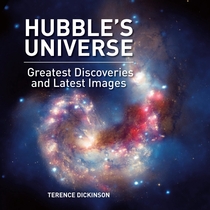
Hubble's Universe
Praise for the first edition: Superbly well produced. Any engagement with this 'cosmic portfolio, ' from picture gazing to deep reading, is grandly rewarded. --Booklist [starred review] The book's precise descriptions and captions brilliantly complement the 300 full-color Hubble images . . . this is an amazing book . . . outstanding. --Library Journal A treasure map to the majesty of our universe. --Publishers Weekly A reminder that the finest telescope in space might also be the greatest camera ever created. --Wall Street Journal The first edition of Hubble's Universe displayed 300 pages of high-resolution celestial portraits selected by bestselling astronomy writer Terence Dickinson from the initial 22 years of the Hubble Space Telescope's exploration of distant galaxies. With the telescope now at the apex of its imaging capabilities, this second edition adds another chapter with more than 36 completely new images, including the first publication of a four-page fold-out of the Andromeda Galaxy, the nearest spiral galaxy to Earth, revealing more than one million individual stars. Thanks to Dickinson's expertise with Hubble's history and discoveries and his access to top Hubble scientists for insight and accuracy, the text includes facts and tidbits not found in any other book. Combined with 330 brilliant images, the clear, succinct and illuminating narrative brings to life the fascinating forces at work in the universe.
See all
Astronomy
For a generation, Astronomy: A Self-Teaching Guide has introduced hundreds of thousands of readers worldwide to the night sky. Now this classic beginner's guide has been completely revised to bring it up to date with the latest discoveries. Updated with the latest, most accurate information, new online resources, and more than 100 new graphics and photos, this Eighth Edition features: ·Website addresses throughout for the best color images and astronomy resources online ·Technical ideas made simple without mathematics ·A beautiful updated full-color, glossy insert with spectacular images ·An interactive format with learning goals, reviews, self-tests, and answers for fast learning
See all
Turn Left at Orion
With over 150,000 copies sold since its first publication, this is one of the most popular astronomy books of all time. This unique guidebook to the night sky shows you how to observe a host of celestial wonders. Its distinct format of object-by-object spreads illustrates how deep-sky objects and planets actually look through a small telescope, while its large pages and spiral binding allow for use outside. Along with updated star names and astronomical information, this new edition provides links to a dedicated webpage with up-to-date tables and images, and an improved planets chapter. The many Dobsonian-friendly images and small telescope views have been revised to account for changes in modern telescope technology, such as larger field of view eyepieces. With dedicated chapters on Northern and Southern Hemisphere objects, it's never been easier to explore the night sky, wherever you are. Additional resources are available on the accompanying website: www.cambridge.org/turnleft.
See all
The Backyard Astronomer's Guide
The touchstone for contemporary stargazers. This classic, groundbreaking guide has been the go-to field guide for both beginning and experienced amateur astronomers for nearly 30 years. The fourth edition brings Terence Dickinson and Alan Dyer's invaluable manual completely up-to-date. Setting a new standard for astronomy guides, it will serve as the touchstone for the next generation of stargazers as well as longtime devotees. Technology and astronomical understanding are evolving at a breathtaking clip, and to reflect the latest information about observing techniques and equipment, this massively revised and expanded edition has been completely rebuilt (an additional 48 pages brings the page count to 416). Illustrated throughout with all-new photographs and star charts, this edition boasts a refreshed design and features five brand-new chapters, including three essential essays on binocular, telescope and Moon tours by renowned astronomy writer Ken Hewitt-White. With new content on naked-eye sky sights, LED lighting technology, WiFi-enabled telescopes and the latest advances in binoculars, telescopes and other astronomical gear, the fourth edition of The Backyard Astronomer's Guide is sure to become an indispensable reference for all levels of stargazers. New techniques for observing the Sun, the Moon and solar and lunar eclipses are an especially timely addition, given the upcoming solar eclipses in 2023 and 2024. Rounding out these impressive offerings are new sections on dark sky reserves, astro-tourism, modern astrophotography and cellphone astrophotography, making this book an enduring must-have guide for anyone looking to improve his or her astronomical viewing experience. The Backyard Astronomer's Guide also features a foreword by Dr. Sara Seager, a Canadian-American astrophysicist and planetary scientist at the Massachusetts Institute of Technology and an internationally recognized expert in the search for exoplanets.
See all
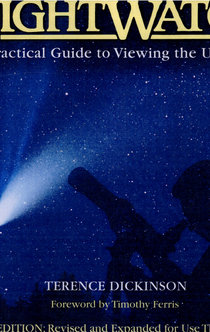
NightWatch
With 250,000 copies in print since its initial publication in 1983, NightWatch has become a standard reference guide for stargazers throughout North America. The new Third Edition expands on that success with a completely revised and updated text, more than 100 new color photos and diagrams and 16 additional pages that cover such! new astronomical pursuits as computerized telescopes, reviews of new telescope designs and accessories, and astronomy on the Internet. All charts, tables and diagrams have been updated and, in some cases, redesigned for easier use. Improved spacecraft measurements of the distances to the stars (recently released by the European Space Agency) are included in the charts, along with additional observing tips for stargazers using binoculars and telescopes. An expanded chapter on Astrophotography lists the best modern films and cameras for skyshooting. The new NightWatch is faithful to the "ultra-simplified, no jargon" philosophy of the original, and at the same time, offers substantially more practical information for the novice and intermediate-level amateur astronomer. The Royal Astronomical Society of Canada called the first edition "the best of its kind"- the new Third Edition is better still. It is still an abundantly illustrated, wide-sized volume designed for easy reference during many starlit nights.
See all



 Share
Share

Comments